
Lexington Busted Booking System
Lexington and Fayette County operate under one consolidated urban-county government, and Kentucky's legislative account of that merger names Lexington as the county's only incorporated city. That structure shapes where every record lives. The Lexington Police Department investigates city incidents and keeps its own reports, while Lexington-Fayette Urban County Government Community Corrections runs the Fayette County Detention Center. The Sheriff's role is court service and warrants, not a second city jail roster. University of Kentucky Police, Kentucky State Police, and federal officers can also make local arrests. Once FCDC accepts someone, Community Corrections creates the booking record and any intake photo. So a Lexington mugshot search and a Fayette County jail search usually end at the same official portal. Population figures back this up: the 2020 Census counted 322,570 residents, and a later estimate put the figure at 329,751 for July 1, 2025. Numbers aside, the records chain stays fixed. Decide first whether you need a police incident report, a jail intake record, or a court disposition, since each has a different custodian.
Where Lexington Busted Mugshots Appear
Go official first. FCDC posts a custody search plus a rolling recent-intake view, while LPD releases reports through an open-records process instead of a daily photo blotter. Newsrooms occasionally run an FCDC-supplied image, though coverage stays selective. Commercial aggregators are another matter. They can keep copied or stale material long after the official entry changes. Check their dates and labels against FCDC and the Fayette court record before trusting anything.
| Channel | Photo | Status | Best use |
|---|---|---|---|
| FCDC current population | When available | Official | Check current custody by name or inmate ID |
| FCDC last 48 hours | When available | Official | Review recent intake, not confirmed present custody |
| Lexington Police news | Selective | Official | Read the agency's own public statement |
| Herald-Leader, WKYT, LEX 18, WTVQ | Selective | News | Find reported cases, then verify officially |
| Busted Newspaper, Mugshots.com, Arrests.org | Often | Unofficial | Discovery only; entries may be stale or wrong |
Neither RecentlyBooked nor Mugshots.zone carries a verified Fayette section for this area. Beware of look-alikes. A page built around a different Fayette County, in another state, has nothing to do with Lexington, Kentucky. Third-party listings never settle questions of custody or identity. The official jail record and the court file remain the checks that count.
Finding Busted Lexington Bookings
FCDC's two views answer different questions. Current Population is a custody snapshot. Booked in the Last 48 Hours works as a recent-intake window, and someone listed there may already be out. Neither view substitutes for the court record. Work through them in order, so a missing result never turns into a false conclusion.
- Search the current population by last name, first name, middle name, or inmate ID.
- Check the 48-hour booking view for a recent intake. Open the public profile to compare booking date, arrest agency, and identifiers.
- If the booking has aged out or the portal is unavailable, submit a focused Community Corrections request with the name, date range, and inmate ID if known.
- Request the LPD incident or arrest report separately when police-held facts are needed.
- Use Fayette District or Circuit Court records to check the case disposition, which means the court's final action on the charge.
The Fayette County booking search lays out the county-wide roster and record trail in more detail. An empty current-population result can mean release, a transfer, a spelling mismatch, or that the person was never booked at FCDC at all. It wipes out nothing. A prior record still exists, and a case outcome still lives with the court. Note: FCDC describes its portal results as live but publishes no fixed refresh interval and no weekly booking archive.
Lexington Arrest Records Requests
LPD and Community Corrections each hold one piece of the same event. Want a police report or a police-held photograph? Ask LPD. Want the booking record or booking image? That goes to Community Corrections, the jail custodian. The LPD open-records page requires a Kentucky-residency statement plus a specific written description. Requests go through JustFOIA, or by email, mail, in-person delivery, and fax. The agency states it responds within five business days. Redactions and lawful access limits can still apply.
- State the person's full name and the narrow date range involved.
- Identify the incident or case number when known and describe the exact report or photograph requested.
- Send police material to LPD; route jail intake material through the LFUCG records portal.
- Keep the request and response so any denial, redaction, or need for clarification is documented.
150 E. Main St.
Lexington, KY 40507
Main: (859) 258-3600
Open Records Unit: (859) 258-3675
The capture below shows the official police-records request page, not a photo gallery. Open the LPD records instructions for current routing before filing anything.
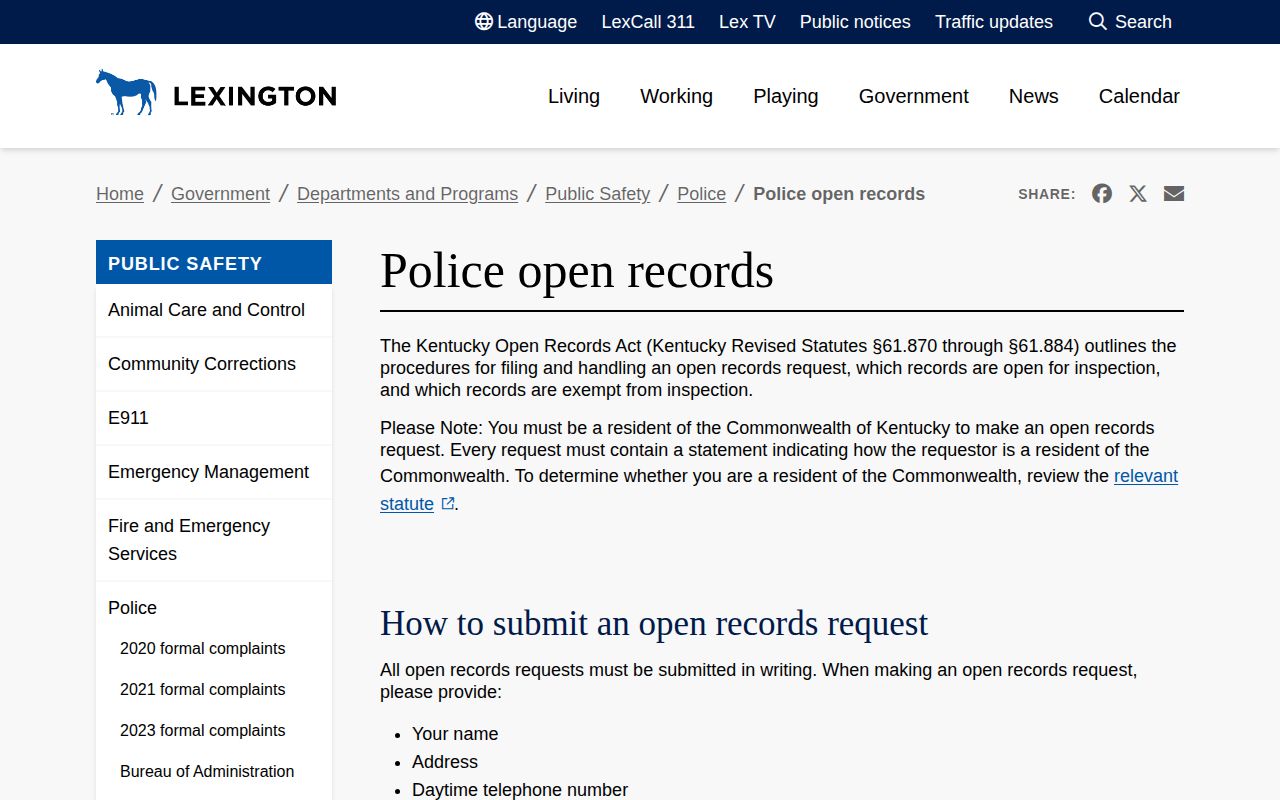
That form path keeps things straight: a police report request goes to LPD, while an FCDC booking-photo request belongs with the jail custodian.
Lexington Arrest News Sources
LPD news releases give the department's own account, but they skip plenty of Lexington arrests. The Herald-Leader crime desk covers crime and courts across Lexington and Central Kentucky. WKYT and LEX 18 run steady regional crime streams, and WTVQ's FCDC archive follows selected detention-center stories. WEKU and WUKY chip in occasional public-radio reporting. Some stories carry a detention-center image. Others use scene footage, police photographs, stock art, or nothing at all. A news report freezes the facts known on its publication date, so read the date and any update note, then compare the agency, booking county, and charge against official records. The Lexington arrest news overview maps local outlets onto the official record path. One more boundary note: Nicholasville, Georgetown, Winchester, Richmond, and Frankfort sit outside Fayette County, even when a regional newsroom groups them beside Lexington stories. Aggregator pages come last. Busted Newspaper runs an unofficial Fayette index, Mugshots.com offers a county search box, and Arrests.org posts dated county bookings. All three can be incomplete, duplicated, or stale, and America's Top Mugshot is unofficial too. A copied image reveals nothing about changed charges, a release, or how the court ruled.
Lexington Arrest Map Limits
LPD keeps no daily blotter pairing mugshots with arrests. Closest thing the department offers is its Community Crime Map, linked from the Crime Data page. Updates land daily. Each entry can carry the crime type, a case number, when the report entered the system, and a public address. Suspect names, victim names, narratives, outcomes, and booking photos are left out on purpose.
Know that gap before you lean on the map. It can place a reported incident in a spot and time frame. It cannot tell you who got busted in Lexington or whether anyone reached FCDC. A map incident and a jail booking come from two different processes. Grab a case number from the map for an LPD request, then turn to FCDC identifiers only if a booking actually happened. The official LPD map page appears in this Lexington-focused capture.
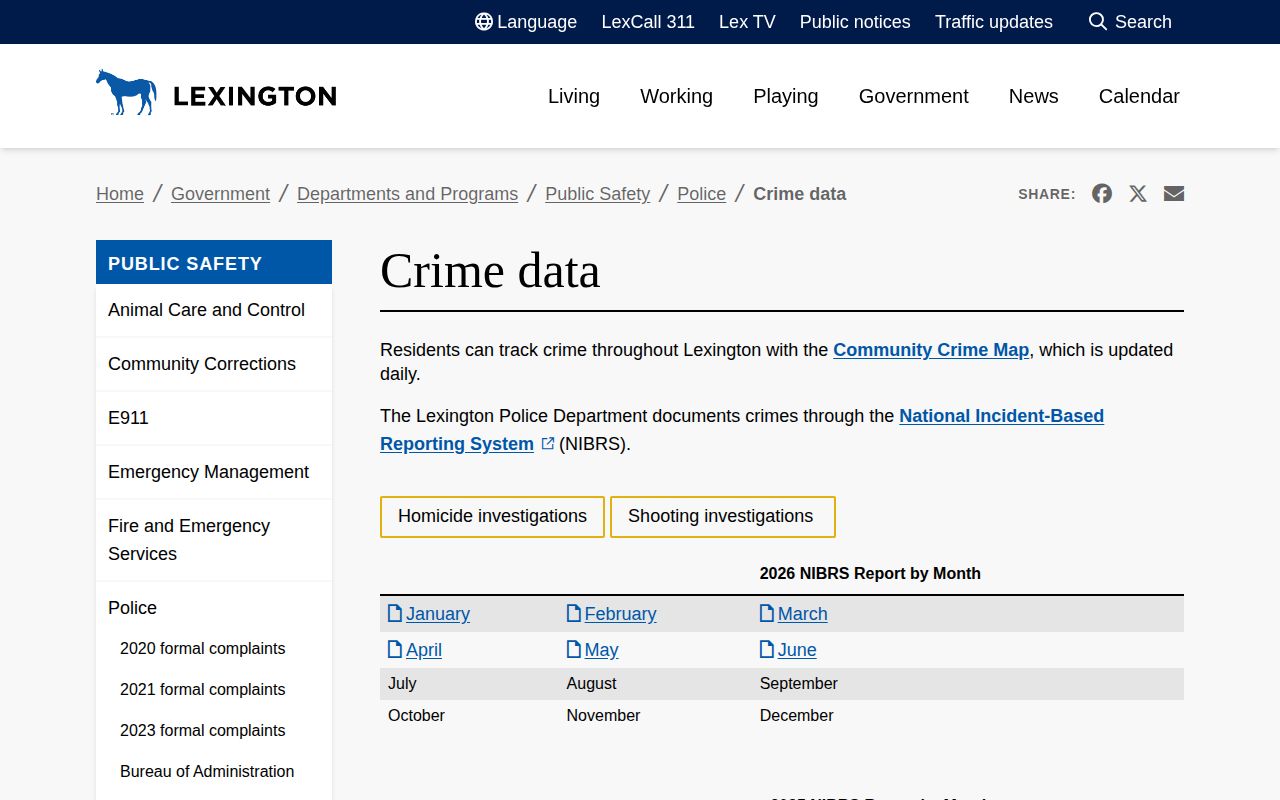
What you see is an incident-data tool. It is not a booking feed, and the blank name and photo fields are there by design.
Lexington Busted Profile Details
Search the FCDC current population a few ways. Last, first, and middle name all work. An inmate ID works too. A result can show a photo when one exists, plus the full name, ID number, birth date, race, sex, height, weight, and expected release date. The recent-booking table draws on much the same identity fields. Open a public profile and you may find more. Arrest date and location, arresting agency, expected release, current offenses, disposition text, and bond or fine amounts can all appear there.
| Field | What it can establish |
|---|---|
| Inmate ID | A stronger match than name alone |
| Booking and arrest dates | When intake and arrest were recorded |
| Arrest agency and location | Which agency brought the case into the jail flow |
| Expected release | A projected field, not a guaranteed release event |
| Charge and bond fields | Charges and bond information recorded at that stage |
Match at least two identifiers before tying an image to a person. A missing photo means the portal shows no image, nothing more. FCDC does not promise every booking image will appear online or stay up after release. The LFUCG retention schedule allows digital mug photographs to be kept for 50 years. Still, retention is not the same as web display or guaranteed release under an open-records request.
Note: An older profile image does not prove a separate arrest unless booking labels and court records back that up.